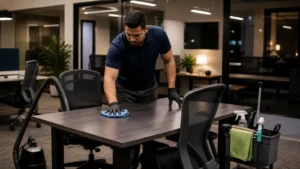
How often should an office be cleaned? The right schedule depends on how many people use the space, how often clients visit, and which areas collect the most daily wear. Many small and midsize offices can start with weekly or biweekly professional cleaning, while busy restrooms, break rooms, entrances, and client-facing areas may need attention more often.
The goal is not to book the greatest possible number of visits. It is to build a schedule that keeps the workplace consistently presentable without paying for work the space does not need.
Use this quick guide as a starting point:
| Office conditions | Schedule to consider |
|---|---|
| Small team, low visitor traffic, limited food use | Weekly or biweekly professional cleaning, with basic upkeep between visits |
| Moderate occupancy, shared kitchen, regular meetings | Weekly service or more often if restrooms and common areas show wear |
| High foot traffic or client-facing reception areas | Multiple visits per week, based on visible conditions |
| Hybrid office with changing attendance | A flexible schedule tied to occupied days and events |
| Special-use or regulated workplace | A site-specific plan that follows applicable requirements |
This is a decision framework, not a universal standard. A walkthrough is the best way to match the schedule to the property.
What Determines How Often an Office Should Be Cleaned?
Square footage matters, but it does not tell the whole story. Two offices of the same size can need very different cleaning schedules. Look at how the space functions each day.
Number of people using the office
More employees generally mean more trash, floor debris, restroom use, fingerprints, and activity in shared spaces. Also account for contractors, delivery drivers, customers, and visitors who are not included in the employee count.
Visitor and client traffic
A back office with limited visitors may stay presentable longer than a reception area, showroom, or professional office that welcomes clients throughout the day. Entrances, interior glass, waiting areas, and conference rooms often show wear first.
Restrooms and break rooms
These areas can determine the schedule for the entire office. Shared sinks, counters, appliances, floors, fixtures, and trash containers receive concentrated use. If they look neglected before the next planned visit, the interval is too long or the between-visit plan needs attention.
Floor type and weather
Carpet can hold visible debris around entrances and workstations. Hard floors may show footprints, dust, and spills quickly. Rain, snow, and deicing material can also change what an office needs during parts of the year.
How the workweek is structured
A hybrid workplace may be quiet on Mondays and Fridays but busy in the middle of the week. Scheduling around the days with the greatest occupancy can be more useful than following a routine built for a five-day, fully occupied office.
A Practical Office Cleaning Schedule
An effective schedule separates frequent maintenance from lower-frequency detail work. Not every task needs to happen during every visit.
Tasks to monitor every occupied day
Employees or an on-site facilities contact may need to address immediate concerns between professional visits, including:
- Food spills and wet floors
- Overflowing trash or recycling
- Restroom supply shortages
- Visible messes in reception and meeting rooms
- Break-room counters after heavy use
- Entrance debris during bad weather
Assign responsibility for these items. A professional cleaning agreement should also state what the cleaning team handles, so tasks do not fall into the gap between staff upkeep and contracted service.
Tasks for recurring professional visits
GVC’s published commercial cleaning services in Baltimore include:
- Vacuuming and mopping floor surfaces
- Dusting desks, shelves, and surfaces
- Cleaning and sanitizing restrooms
- Emptying trash and replacing liners
- Wiping common areas, break rooms, and kitchens
- Cleaning interior glass doors and windows
- Sanitizing high-touch surfaces such as doorknobs, switches, and handles
The checklist and frequency should be confirmed for the specific workplace. For example, an office may need restroom and floor care at every visit but schedule detailed dusting or interior glass on a different rotation.
Periodic detail cleaning
Some tasks are better handled on a planned rotation or when conditions call for them:
- Detailed baseboard and trim cleaning
- Carpet cleaning
- Seasonal deep cleaning
- Interior glass beyond routine spot cleaning
- Cleaning after an event
- Post-construction cleaning after approved projects
GVC lists one-time commercial cleaning for special events, post-construction work, and seasonal deep cleans. Confirm the exact scope during the estimate.
Weekly vs. Biweekly Office Cleaning
GVC states that most of its commercial clients choose weekly or biweekly service. The better option depends on how quickly the workplace changes between visits.
Weekly service may fit when:
- The office is occupied most weekdays.
- Employees share a kitchen or break room.
- Clients visit regularly.
- Restrooms show visible wear within several days.
- Floors collect debris quickly.
- Staff should not be responsible for routine cleaning.
Biweekly service may fit when:
- The team is small or works a hybrid schedule.
- Visitor traffic is limited.
- Employees handle spills and basic tidying between visits.
- The office has few shared facilities.
- The space remains presentable for more than one week.
Biweekly service is not automatically the less expensive choice if each visit requires more time because dirt and trash have accumulated. Compare the scope of work and expected condition, not only the number of appointments.
When an Office May Need Cleaning More Than Once a Week
Consider increasing the frequency when:
- Trash containers overflow before the next service.
- Restrooms develop odors or look untidy during business hours.
- Entrance floors remain visibly dirty.
- Glass doors collect fingerprints quickly.
- Food waste stays in the office for several days.
- Employees complain about shared spaces.
- Clients see the office in a condition that does not reflect the business.
- The workplace has recently increased its staff or operating hours.
You may not need to increase every task. A cleaner can prioritize restrooms, break rooms, trash, floors, and entrances more frequently while rotating lower-priority detail work.
How Hybrid Work Changes the Cleaning Plan
A hybrid schedule can reduce traffic, but it can also concentrate activity into a few busy days. Cleaning an empty office on a fixed schedule may waste part of the budget, while cleaning too early before an all-hands day may leave the workplace untidy when it matters most.
Track occupancy for several weeks and note:
- The busiest in-office days
- Meeting and event schedules
- Days when visitors are expected
- When restrooms and kitchens show the most use
- How long trash and food waste remain onsite
Then schedule cleaning before or after peak days. Review the arrangement when staffing patterns change.
Cleaning Is Not the Same as Disinfecting
Cleaning removes dirt and impurities from surfaces. Disinfecting uses chemicals to kill germs that remain. The CDC’s facility cleaning guidance advises cleaning visibly dirty surfaces and cleaning before disinfecting. It also explains that additional disinfection may be appropriate when someone has been sick or when public health authorities recommend it.
Routine offices should not use medical or regulated-facility standards as a generic template. Healthcare, food-service, childcare, manufacturing, and other specialized environments may have requirements beyond ordinary office cleaning. Discuss the facility type and any applicable rules before agreeing to a scope.
Questions to Ask Before Choosing a Cleaning Schedule
Before accepting a proposal, ask:
- Which areas will be cleaned during every visit?
- Which tasks will follow a weekly, monthly, or seasonal rotation?
- How will restrooms, break rooms, entrances, and high-touch surfaces be handled?
- Can the frequency change if office attendance changes?
- Are supplies, equipment, and trash liners included?
- Can cleaning happen before opening, after closing, or on weekends?
- How are special events or one-time deep cleans priced?
- What should employees handle between visits?
- How will missed areas or service concerns be addressed?
A useful proposal should make the schedule and responsibilities clear. It should also reflect the actual office rather than applying the same checklist to every business.
Building an Office Cleaning Schedule in Baltimore
GVC Cleaning Company provides commercial cleaning for Baltimore offices, retail spaces, and managed properties. The company offers scheduling before opening, after closing, and on weekends, which allows businesses to plan service around their operations.
Start with a walkthrough of the workplace. Identify the busiest areas, decide what needs attention every visit, and separate those tasks from periodic detail work. After the first few appointments, review the condition just before the team arrives. If the office still looks good, the frequency may be appropriate. If shared areas consistently fall behind, adjust the schedule or scope.
Want a cleaning plan based on how your office actually operates? Request a free estimate from GVC Cleaning Company or call 443-714-1374.
Frequently Asked Questions
How often should a small office be professionally cleaned?
A small, low-traffic office may be able to start with weekly or biweekly professional cleaning, provided employees handle spills and basic upkeep between visits. Shared restrooms, food waste, client traffic, and floor conditions can make more frequent service appropriate. Review the office immediately before each visit to see whether the interval is working.
Should an office be cleaned every day?
Not every office needs a full professional clean each day. High-traffic or heavily occupied workplaces may benefit from frequent service, while smaller or hybrid offices may need less. Immediate issues such as spills, overflowing trash, restroom supplies, and food waste should still be addressed on occupied days.
What areas of an office need cleaning most often?
Restrooms, break rooms, entrances, trash stations, interior glass, and frequently touched surfaces usually show use sooner than private offices or low-traffic storage areas. Build the cleaning schedule around the fastest-changing areas, then place dusting and detail work on an appropriate rotation.
Is weekly or biweekly office cleaning better?
Weekly cleaning may suit regularly occupied offices with shared kitchens, client visits, and busy restrooms. Biweekly service may fit small or hybrid teams with low traffic and reliable between-visit upkeep. The better choice is the interval that maintains the agreed condition without allowing waste, odors, or visible dirt to accumulate.
Can office cleaning happen after business hours?
Yes. GVC states that commercial cleaning can be scheduled before opening, after closing, or on weekends. Discuss building access, alarms, keys, restricted areas, and the preferred cleaning window before service begins.
How can I tell if our office needs more frequent cleaning?
Overflowing bins, restroom complaints, food odors, dirty entrances, visible floor debris, and fingerprints on client-facing glass are clear signs. If these problems appear well before the next visit, increase the frequency for priority areas or revise the checklist.