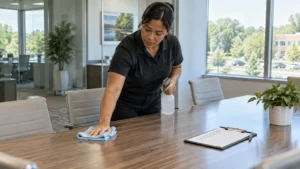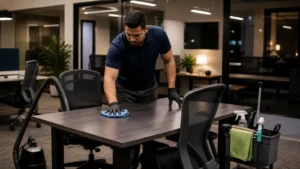
An office cleaning checklist works best when it separates quick daily upkeep from the more detailed work that belongs on a weekly or monthly schedule. For a Baltimore County business, the right plan depends on foot traffic, shared spaces, flooring, restroom use, and the hours when cleaning can take place. Use the guide below as a starting point, then adjust it to your workplace.
Office cleaning checklist at a glance
- Daily or every scheduled visit: remove trash, address spills, clean restrooms, wipe breakroom counters, tidy shared areas, and care for high-traffic floors.
- Weekly: dust accessible surfaces, clean interior glass, detail workstations and conference rooms, and give floors and breakrooms closer attention.
- Monthly or as needed: clean lower-traffic areas, inspect edges and corners, dust vents and ledges, and review whether the current schedule still matches building use.
This is a planning guide, not a fixed rule for every office. Some daily items may be handled by employees between professional visits. A written scope of work should state who handles each task and how often it is completed.
A practical office cleaning checklist by frequency
A useful checklist answers three questions: what needs attention, how often it needs attention, and who is responsible. Start with the areas that employees and visitors use most. Then add lower-traffic spaces and periodic detail work.
Daily tasks or tasks for every scheduled visit
These tasks help keep visible, frequently used areas ready for the next workday. If your professional cleaning schedule is weekly or biweekly, decide which items your team will handle between visits.
- Empty trash and recycling containers and replace liners when needed.
- Remove obvious debris and address spills promptly.
- Vacuum or mop high-traffic floor areas based on the floor type.
- Clean and restock restrooms according to use.
- Wipe breakroom counters, sinks, tables, and other shared surfaces.
- Tidy reception areas, conference rooms, and shared workspaces.
- Wipe frequently touched surfaces that are part of the agreed cleaning scope.
- Check entry glass and interior glass for visible fingerprints or marks.
For many offices, the lobby, restrooms, breakroom, and main walking paths show wear first. Giving those areas priority can make the entire workplace feel more orderly.
Weekly office cleaning tasks
Weekly work goes beyond quick upkeep. It addresses dust, buildup, and spaces that may not need detailed attention every day.
- Dust accessible desks, ledges, shelving, and office furniture included in the scope.
- Vacuum carpeted areas thoroughly, including accessible edges.
- Mop hard floors and pay attention to corners and transition areas.
- Clean conference tables, chairs, and shared work surfaces.
- Clean interior glass, glass doors, and partitions as agreed.
- Give breakroom appliances, cabinet fronts, and splash areas exterior cleaning.
- Clean restroom fixtures, partitions, mirrors, and floors in detail.
- Wipe baseboards or spot-clean walls where marks are visible.
Your office may need some of these tasks more often. A busy customer-facing space will usually need a different routine than a small office with limited visitors.
Monthly and periodic office cleaning tasks
Monthly work helps prevent neglected areas from becoming distracting. These tasks can also be scheduled quarterly or simply as needed, depending on the building.
- Dust accessible vents, higher ledges, door frames, and light fixtures.
- Clean behind movable furniture where safe and practical.
- Inspect floor edges, corners, and areas under conference tables.
- Review interior glass for buildup that spot cleaning may have missed.
- Check storage rooms, supply areas, and other lower-traffic spaces.
- Spot-clean doors, frames, switch plates, and visible wall marks.
- Review recurring problem areas and update the written checklist.
Periodic projects should be clearly separated from routine janitorial work. If your office needs a one-time detailed clean, ask whether it should be quoted separately from recurring service.
Adjust the checklist to the way your office is used
A checklist copied from another business may miss the areas that matter most in yours. Walk through the building during a normal workday and note where people enter, gather, eat, and share equipment.
Use these factors to set priorities:
- Employee and visitor traffic: More people usually means faster trash accumulation and more visible wear in entries, restrooms, and shared rooms.
- Work schedule: Evening or weekend access may reduce disruption for employees and customers.
- Flooring: Carpet, tile, and other hard surfaces need different tools and routines.
- Shared desks and meeting rooms: Flexible workspaces can create extra touchpoints and more frequent turnover between users.
- Food and drink: A heavily used breakroom may need more frequent attention than a small kitchenette.
- Weather and entrances: Rain, winter grit, and outdoor debris can change the amount of floor care needed near doors.
If you are still deciding on a service schedule, GVC’s guide to how often an office should be cleaned explains how traffic, staffing, and building use affect frequency.
Cleaning and disinfecting are different tasks
Routine cleaning removes dirt and impurities from surfaces. Disinfecting uses a product intended to kill remaining germs and may be appropriate in specific situations. The CDC’s facility cleaning guidance says regular cleaning is often enough for many facilities and recommends giving high-touch surfaces regular attention. Additional disinfection may be appropriate when someone is obviously ill or when a facility has specific requirements.
Avoid using the words “clean” and “disinfect” interchangeably in a service agreement. Ask what is included, which surfaces are covered, and whether any special product or dwell-time requirements apply. Offices with regulated or industry-specific requirements should follow the rules that apply to their facility.
Turn your checklist into a clear scope of work
The checklist becomes much more useful when it is attached to a written scope of work. This gives the office manager and cleaning company the same reference point and reduces misunderstandings.
For each area, record:
- The space: reception, private offices, conference rooms, restrooms, breakroom, halls, and other included areas.
- The task: vacuum, mop, dust, clean glass, remove trash, or another clearly stated action.
- The frequency: every visit, weekly, monthly, or as requested.
- The responsibility: cleaning provider, office staff, property management, or another party.
- Access notes: preferred hours, alarm procedures, locked rooms, and spaces that should not be entered.
Add a simple way to report missed items or changing needs. An office renovation, staffing change, busy season, or new tenant can make an old checklist inaccurate.
What to clarify before comparing office cleaning quotes
Two quotes can look similar while covering very different work. Give each company the same room list and task schedule so you can compare the proposed service fairly.
Ask these questions:
- Which rooms and tasks are included in the recurring price?
- Are supplies, trash liners, or consumable restroom products included?
- Which tasks are considered periodic or an additional service?
- Can cleaning be scheduled before business hours, after hours, or on weekends?
- How should your team report a concern or request a checklist change?
- What needs to be moved or secured before the cleaning visit?
Photos can also help you compare expectations. Review GVC’s cleaning project gallery to see examples of completed work, then identify the results that matter in your own space.
Signs your current checklist needs an update
A cleaning schedule should change with the office. Review it if you notice repeated overflowing trash, restroom supply problems, visible debris soon after service, neglected corners, or recurring complaints about the same area.
The answer is not always a more frequent full-office cleaning. You may need to increase attention in one high-use zone, add a periodic task, or clarify who handles spills and quick upkeep between visits. A targeted change can be easier to manage than rewriting the entire plan.
Planning office cleaning in Baltimore County
GVC Cleaning Company provides commercial cleaning services for offices and other businesses in its verified service area, including Baltimore County communities such as Towson, Lutherville-Timonium, Owings Mills, Pikesville, White Marsh, Middle River, Parkville, and Essex. The company also serves listed areas in Baltimore City, Howard County, and Anne Arundel County.
GVC’s commercial cleaning page lists recurring and one-time options, with scheduling available before or after business hours and on weekends. Services can include floor care, dusting, restrooms, trash removal, common areas, breakrooms, interior glass, and high-touch surfaces according to the agreed plan.
If you want a checklist tailored to your facility, request a free estimate from GVC. Share your office size, preferred schedule, highest-traffic areas, and the tasks that matter most. That information gives the team a clearer starting point for your quote.
Frequently asked questions
What should be included in an office cleaning checklist?
An office cleaning checklist should name each included room, the task required, the frequency, and the responsible party. Common categories include trash, floors, dusting, restrooms, breakrooms, conference rooms, interior glass, and shared surfaces. Access instructions and a process for reporting concerns also help keep expectations clear.
How often should an office be professionally cleaned?
The right frequency depends on employee count, visitor traffic, restroom and breakroom use, flooring, operating hours, and the image the business needs to maintain. Some offices choose weekly or biweekly professional service while handling quick daily tasks internally. Higher-traffic facilities may need more frequent attention in selected areas.
Which office areas usually need attention every visit?
Entries, restrooms, breakrooms, trash containers, shared rooms, and high-traffic floors commonly need attention at every scheduled visit. The exact list should reflect how your building is used. A small private office may have different priorities from a customer-facing location with frequent visitors.
Is cleaning the same as disinfecting?
No. Cleaning removes dirt and impurities from surfaces, while disinfecting uses a product intended to kill germs that remain. Routine cleaning is often sufficient for many facilities. Disinfection may be added for particular circumstances or facility requirements, so the scope should state clearly which service is expected.
How can a small office compare cleaning quotes?
Give each cleaning company the same room list, task checklist, and requested schedule. Ask what is included, what costs extra, who supplies consumable items, and how concerns are handled. Comparing a shared scope of work is more useful than comparing prices that may cover different tasks.
Can an office cleaning checklist change over time?
Yes. Review the checklist after staffing changes, renovations, schedule changes, seasonal weather, or repeated issues in one area. You may need to change only a task or zone rather than the entire service. Regular reviews keep the plan aligned with the way the office actually operates.
Build a cleaning plan around your workplace
A clear checklist gives your team consistent expectations. If your Baltimore County office needs recurring or one-time commercial cleaning, GVC can review your space, schedule, and priorities with you.